


Neem contact met ons op. We zijn bereikbaar op werkdagen van 08:30 tot 17:00 uur.


Replace your EtherCAT servo without changing your controller

Keep your existing EtherCAT master
Less commissioning time. Less fine-tuning. Less risk when switching.

Key benefits

Better performance
Less vibration and faster stabilisation under high dynamic conditions.

Simple commissioning
Within a single ecosystem, switching to a different servo platform appears to carry significant risks and have a major impact. With Delta, you can replace the drive without having to modify your existing EtherCAT network or controller.

Ecosysteem compatibiliteit
Within a single ecosystem, switching to a different servo platform appears to carry significant risks and have a major impact. With Delta, you can replace the drive without having to modify your existing EtherCAT network or controller.
Servo series for various machines and processes
-
 AC Servo Systems
AC servo motors and control systems make the difference in automated control. Increasingly advanced microprocessor unit technology and the evolution and optimisation of manufacturing permanent magnet servo motors and high-performance semiconductors enable them to meet diverse customer and application requirements.
All servo drives in the ASDA series are equipped with an advanced digital signal processor (DSP) for fast performance of control circuits. In addition, additional ASDA series features such as gain tuning, smooth motor operation and software analysis/monitoring ensure fast and highly accurate motion control in a range of industrial automation solutions.
We supply motors up to 1 kW with high-quality connectors as standard.
-
 ASD-A3
With automatic tuning and a user-friendly interface for system analysis, the ASDA-A3 series offers a bandwidth of 3.1 kHz and utilises a 24-bit absolute encoder. Benefits include excellent response, accurate positioning, and stable yet flexible performance. The series also has new features such as vibration suppression, system diagnostics and a shared DC bus design that can regenerate energy. Delta's ASDA-A3 series AC servo system is a comprehensive technological solution that can improve machine precision and achieve excellent performance.
Available from 0.4 to 15 kW in 3~400 Vac.
Highly suitable for use in applications such as:
- Semiconductor handling and manufacturing
- CNC and machine tools
- High-speed handling & logistics systems
- Graphic and digital printing systems
-
 ASD-B3A
The ASDA-B3 series is distinguished by high tolerance and stable operation. This creates a highly efficient and user-friendly working environment. The precise motion control functions improve production efficiency and quality.
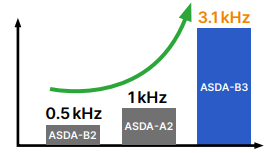
High Response Bandwidth B3 These servo drives have increased speed and torque and offer advanced features such as safe torque off, PR mode, and EtherCAT communication. The ASDA-B3 series meets the needs of today's manufacturing environments.
Available in:
- 1~230 Vac from 0.1 to 1.5 kW
- 3~230 Vac 2 and 3 kW
-
 ASD-W3
Het Delta W3 servosysteem is een high-end, modulair servoplatform gericht op multi-axis toepassingen met hoge snelheid en nauwkeurigheid. De EtherCAT uitvoering is specifiek ontworpen voor gesynchroniseerde motion control en complexe automatisering.
Belangrijkste kenmerken:
27-bit absolute encoder (hoge resolutie)
Bandbreedte tot 3,5 kHz
Zeer snelle respons en korte insteltijd
Multi-axis synchronisatie via EtherCAT
Hoge positioneernauwkeurigheid en tracking performance
Lage en hoge frequentie trillingsonderdrukking
Friction compensation en closed-loop regeling
Belangrijkste functies:
Ingebouwde motion control (geen externe motion controller nodig voor basisfuncties)
Ondersteuning voor gantry, interpolatie en multi-axis bewegingen
Geavanceerde auto-tuning en systeemanalyse
Capture- en vergelijkingsfuncties
Synchronisatie van meerdere assen via EtherCAT


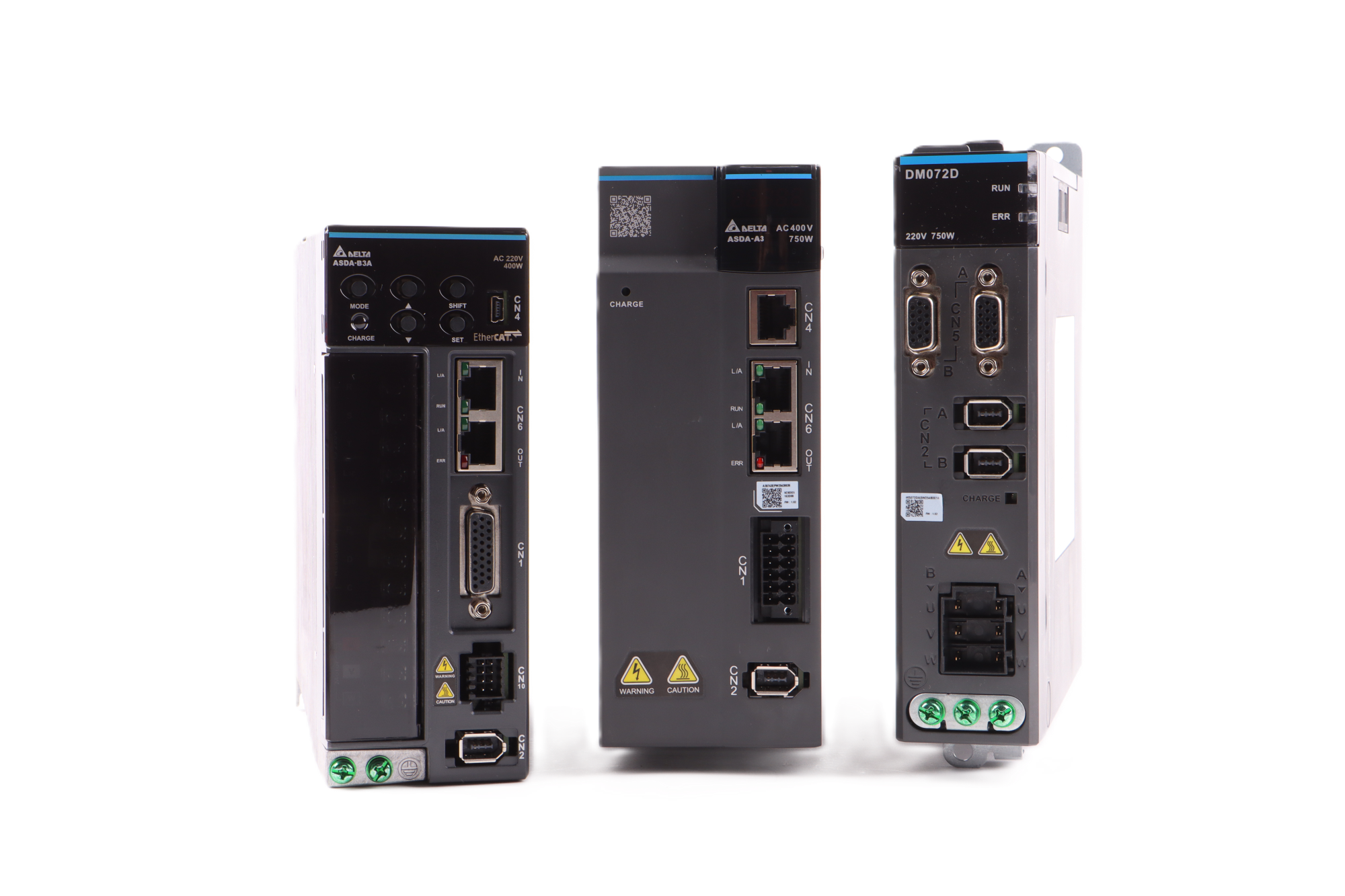
Switching without taking unnecessary risks

Check compatibility beforehand
We assess the controller, network, encoder, safety and motion control systems in advance. This means you know in advance what areas require attention when replacing or migrating the system.

Test on a single axis first
We prefer to test new servos first on a single axis or test rig. This allows us to check the tuning, communication and behaviour before deploying them on the machine.

Commissioning support
We provide support with parameter settings, tuning and diagnostics. Remotely or on-site, depending on the machine and the situation.
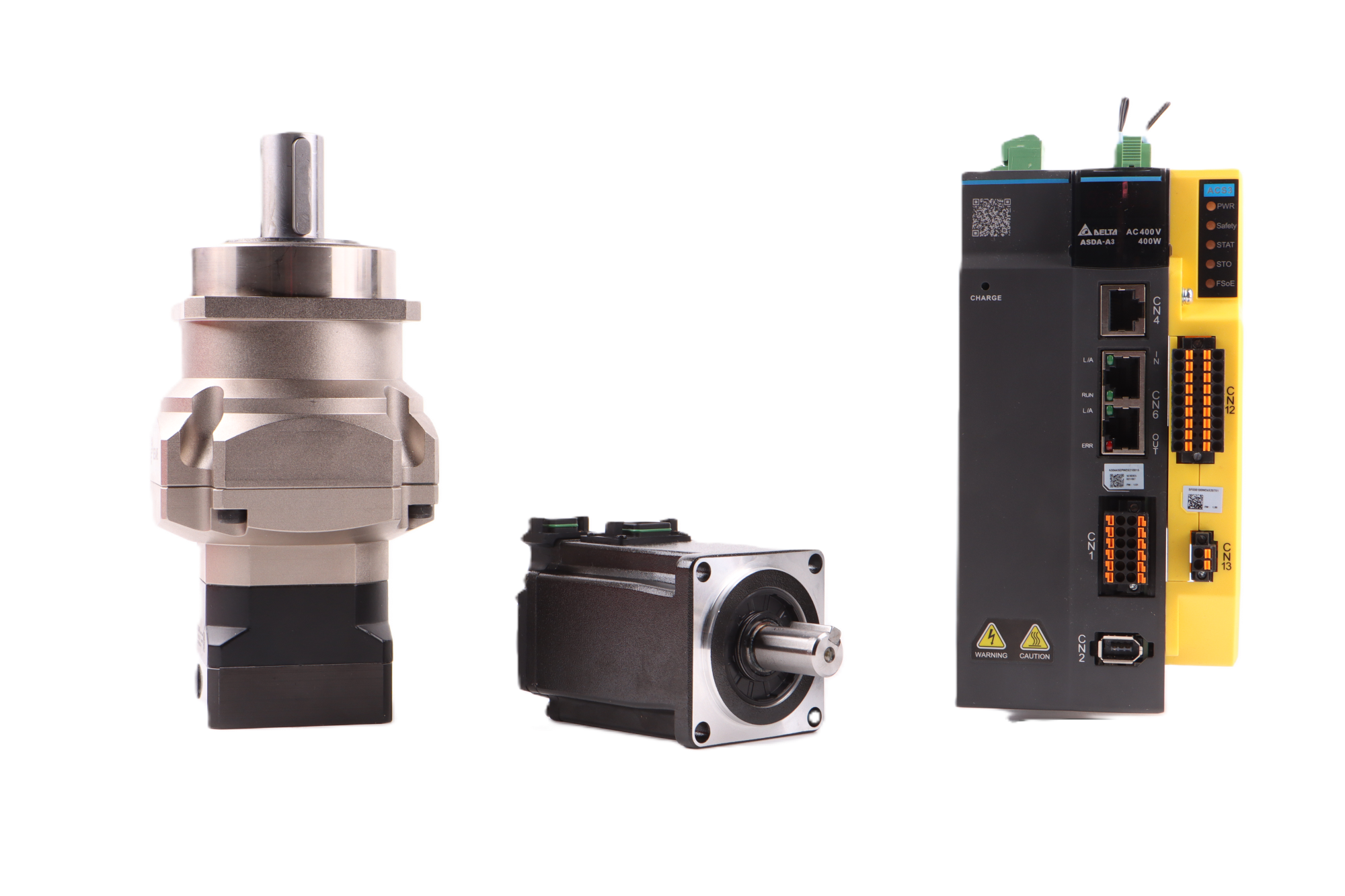
Which series is right for your project?
Below are examples of applications and scenarios, with an explanation of why a particular series is recommended:
| Scenario / application | Explanation | Recommended series |
| Upgrade / replacement of B2 systems | Logical successor with improved tuning and performance | B3 |
| CNC applications | Higher bandwidth and more stable control | B3 |
| Simple motion without a PLC | Internal motion generator available | B3 |
| General machine building | Reliable and versatile, sufficient performance | A3 |
| Cost-effective solution | Good balance between price and performance | A3 |
| Multi-axis synchronisation | Native EtherCAT synchronisation between axes | W3 |
| Machines requiring high positioning accuracy (robotics, semiconductors) | High resolution and advanced motion control | W3 |
| Maximum accuracy requires | a 27-bit encoder and top performance | W3 |
What are the differences between the series?
Below is an overview of the key specifications
| Feature | A3 series | B3 series | W3 series |
| Positioning | High-end | Mid/high-end | Multi-axis motion |
| Encoder | 24-bit | 24-bit | 27-bit |
| Bandwidth | 3,1 kHz | 3,1 kHz | ca. 3,5 kHz |
| Max. motor speed | 6000 rpm | ||
| Motion control | Basic | Enhanced | Multi-axis synchronisation and interpolation |
| Multi-axis | Limited | Limited | Extensive |
| PID tuning | Good | Simpler | Advanced |
| Vibration suppression | Yes | Verbeterd | Geavanceerd |
| Inertia tolerantie | Normaal | Improved | Advanced |
| STO | Available | SIL2 | SIL3 |
| DC-bus sharing | Yes | Yes | Yes (centralised) |
| Power range | Up to 15 kW | A few kW | Modular |
| Application | General | CNC/machine building | High-end / robotics |
| Complexity | Average | Average | High |
A3 safety option card
The A3 servo offers an option card for FailSafe over EtherCAT (FSoE)
The benefits at a glance:
- High level of integration:
- Transmits standard data and safety data over the same network, without the need for a separate safety bus.
- Compared to I/O-based solutions, FSoE simplifies cabling and reduces installation and maintenance costs.
- High reliability:
- Includes robust error detection and validation mechanisms, such as Cyclic Redundancy Check (CRC) and timeout monitoring.
- This ensures data integrity and reliable communication, even in the event of faults.
- Complies with international safety standards:
- Certified by TÜV and compliant with IEC 61508, SIL 3 and ISO 13849 PL e.
- It therefore meets the highest industrial safety requirements.

From simple applications to multi-axis motion
Servo system with planetary gearboxes
Sesame planetary gearboxes are renowned for their high precision, high torque, high efficiency and low backlash. Thanks to their compact design and advanced gear technology, they offer low backlash and quiet operation. A major advantage is that they are maintenance-free throughout their entire service life and do not require any lubricant replacement.
We also supply worm and/or bevel gear reducers from Varvel and/or Cidepa.

FAQ about our EtherCAT servo systems
Fast and reliable communication is essential for modern servo systems. EtherCAT is therefore one of the most widely used industrial Ethernet protocols for motion control.
A key advantage of EtherCAT is its high speed. Unlike traditional Ethernet, all data for the various devices is consolidated into a single network message. This allows devices to read and write their data immediately as the message travels through the network. This minimizes communication delays and ensures very fast cycle times.
In addition, the network structure is simple. EtherCAT devices can be daisy-chained directly one after another, often eliminating the need for additional switches. This makes the network easy to manage and practical for machines and long production lines.
Thanks to this combination of speed, efficient data transfer, and simple network architecture, EtherCAT is ideally suited for applications involving servo drives and high-speed motion control.
In short: EtherCAT is suitable for fast and precise motion control without a complex network structure.
A Delta Electronics servo system can be easily integrated into an existing machine or production line.
With features such as autotuning, commissioning can be carried out quickly and efficiently. This allows the system to be put into operation without lengthy adjustment processes.
Innomotion also provides support in selecting components and during the initial commissioning. If needed, we can do this on-site as well. This ensures that the integration goes smoothly and that the system works properly right away within the existing setup.
If you have any questions during the process, our technical experts are here to provide practical support.
Delta Electronics’ servo systems integrate seamlessly with existing EtherCAT environments. In many cases, the existing program can remain in place, and the use of specific Delta software is not required.
This keeps the integration straightforward and practical, without unnecessary adjustments or additional instructions.
The EtherCAT motion control fieldbus is an open standard that uses an ESI (EtherCAT Slave Information) file to configure the functions and associated object properties of each slave.
An ESI file is typically a standard XML file.
Integration with non-Delta controllers
Import the ESI file from the slave device into the controller software.
This allows the controller to recognize the device and control it according to the configuration in the ESI file.
An ESI file can contain data from multiple devices.
Download the ESI file from the article on our website.
After importing into the controller software, the ESI file is usually saved in the following locations (this may vary):
Beckhoff TwinCAT
- TwinCAT 2: C:\TwinCAT\IO\EtherCAT
- TwinCAT 3: C:\TwinCAT\3.1\Config\Io\EtherCAT
Omron Sysmac Studio
- C:\Program Files (x86)\OMRON\Sysmac Studio\IODeviceProfiles\EsiFiles\UserEsiFiles
Safety Integrated into Your Network (FSoE)
With FailSafe over EtherCAT (FSoE), you can combine motion and safety in a single network.
No separate safety bus is needed, yet you have full control.
Why this matters
- No extra cabling for safety
- Fewer components in your control cabinet
- Simpler installation and maintenance
What this means technically
- Safety and standard data over a single EtherCAT network
- Reliable communication with CRC and timeout monitoring
- Complies with SIL 3 and PL e safety standards
What are the benefits?
- Lower installation costs
- Reduced engineering complexity
- Faster integration of safety into your machine
See below for instructions on connecting a Beckhoff controller to an ASDA-A3 servo from Delta Electronics
Below is an overview of all safety functions of the A3 series servos that comply with the IEC 61508, SIL 3 safety standards.
| Safety Function | Function | Application |
|---|---|---|
| Safe Torque Off (STO) | Disables the output power of the servo drive. The motor no longer delivers torque. | Maintenance, emergency stop, prevention of unintended startup |
| Safe Stop 1 (SS1) | The motor decelerates in a controlled manner to a standstill within a set time or ramp, and then automatically switches to STO. | High-speed applications or applications with a risk of machine damage |
| Safe Stop 2 (SS2) | The motor decelerates in a controlled manner to a standstill, but motor torque remains available to hold position. | Precise positioning and controlled stopping |
| Safe Operating Stop (SOS) | Holds the motor stationary with active control, ensuring position is maintained and a quick restart is possible. | Robot positioning and high-precision applications |
| Safe Limited Speed (SLS) | Monitors motor speed and intervenes if the set limit is exceeded (stop or controlled deceleration). | Safe operation during runtime, for example during manual interaction |
| Safe Maximum Speed (SMS) | Limits the maximum motor speed to a fixed safe value. | Applications where speed must be structurally limited |
| Safe Speed Monitoring (SSM) | Continuously monitors whether the motor speed remains within a safe limit. | Situations where operators must be able to approach safely |
| Safe Incremental Movement (SIM) | Limits the motor’s movement to a predefined range or path. | Controlled movement within a limited space |
| Safe Direction (SDI) | Limits movement to a single safe direction and prevents unwanted reverse movement. | Vertical axes or applications with a risk of falling |
| Safe Limited Position (SLP) | Defines and monitors a safe working area for the motor position. | Robots, axes, and lifting platforms |
| Safe Brake Control (SBC) | Controls the mechanical brake via a safe output signal. | Applications where a brake must be actively controlled |